Wednesday, December 10, 2008

Poetry and Prose


What makes a story triumph against the test of time? Is it a fantastic plot, or beautiful writing? Is it both, or something more? Well, I am not sure what the correct formula is to overcome the ultimate critic of time, but I do know that William Shakespeare’s Hamlet is a work that has conquered the years. While reading this play I could feel the changed times, for Shakespeare’s language is antiquated, his setting is from an older time period, yet this work remains beautiful.

I think that it is amazing to read Shakespeare and still be able to admire his writing capabilities. In general I prefer poetry over prose, so mostly, I prefer to read Shakespeare’s sonnets over his plays. However, large portions of Hamlet do have metric structure, setting it apart from the normal prose, and in in my opinion these are the portions of the play that stand as the most beautiful.

Take for instance, Prince Hamlet’s “To be or not To be” soliloquy, one of the most famous of all time. In this speech the reader sees Shakespeare’s writing abilities in a way that can be hidden by prose. From this personal discourse I see beautiful illustrations and deep questions contemplated, both which make wonderful poetry. “When we have shuffled off this mortal coil” these words illustrate death in such a lovely way it makes one think that death may not be such a harsh happening, and this is of what Prince Hamlet is trying to convince himself. Like I stated earlier, I don’t know what makes a piece of literature great for eternity, but I do know what makes it great for me, and Hamlet is great because it has a powerful plot, yet maintains its poetic allure.

“A Declaration of a Strange and Wonderful Monster”


This pamphlet is fascinating for so many reasons. Mostly, however, because it so clearly depicts the political, and religious tensions that existed in England after the English Civil War. It also shows the extreme bias of the author which is rather comical at times due to his excessive zeal.

This pamphlet describes the birth of a deformed child to a woman, it opens with- “This wonderful manifestation of God’s anger, against wicked and profane people”. From this opening, the author strongly states his opinion as fact so that the reader understands the monstrous birth was due to God’s just wrath against a foul sinner. He then goes on to discuss the sins that resulted in the deformity labeling the people of the region as “very bad” in the fact that they are “Papists” (a person who practices Roman Catholicism) thus accusing all Roman Catholics as evil. Probably, the best accusation, however, comes on the front page where it says that the mother “had wished rather to bear a child without a head rather than a Roundhead”. This statement declares that due to the mother’s political standings (as in support of a more Catholic rule, instead of the Roundhead, Puritanical rule), her child was born deformed.

In this article the author makes many blatant accusations as to what is evil in the sense of religion and government, and it fascinates me to see the fervor with which the author attacks the “Papists”. In many ways this article is a form of propaganda, but I suppose the readers of this work rather considered it more of a tabloid than a reliable source. Nonetheless, it contains scathing assertions that illustrate the turmoil that once existed in England.

Hmmmm, Seems Fishy...


While I was reading through the various witch pamphlets something interesting caught my attention. The majority of the times that “witches” were caught and accused, they were charged on the grounds of doing something to someone else instead of doing something for themselves (like finding a pot of gold or something like that). Take for instance the confession of “Mother Waterhouse of Hatfield Peverell” who used her familiar (a cat) to kill three of a man’s hogs out of a supposed hatred for the man. Now, the interesting point arises when one looks at how the accusations are created as revenge cases against other people, for most witches were primarily accused because something went wrong with a neighbor, or towns-person.

This type of vengeance based accusation sheds a lot of light on the idea of witches for the time period. For during the time period I am sure that, to those living during the time, many strange happenings occured, children would become instantly sick, livestock would confusingly perish, and natural disasters were just as common then as now. People needed excuses for these baffling occurrences, and who was more easy to blame than the ugly, family-less woman. So, it makes sense that innocent people were accused of witchery, but the problem arises when one reads that the people accused actually confessed to that which they were accused. Maybe, it was because they were weary of their societies rejection and decided to just accept the accusations or maybe, it was because they truly did have dealings with the devil, I suppose we will never really know.

Friday, December 5, 2008

Why Can’t I Go to Hogwarts?


As I read through Harry Potter once again I am struck by its realism. I remember reading somewhere that J.K. Rowling daily recieved letters from children who were writing very distraught about why they had never been sent their letters of acceptance into Hogwarts School of Witch Craft and Wizardry. This point only goes to show how effectively she created her separate wizarding society.

It amazes me how Rowling so flawlessly incorporates he alternate universe into our own. Unlike almost all other works of fantasy where a whole new world is created, Rowling writes her world living silently amongst ours, and it is so believable. Readers are drawn to new worlds like Middle Earth, but when this new world is living with us one is even more drawn. In many ways I think this is one of the reasons that the stories are so successful because it took a new kind of genius to think of the idea that we can relate such a new idea of a world amongst our own society hiding but still thriving. There world may be just around the corner but no one will never know.

I tell people that ever since the fourth grade, when I first started reading Rowling’s series, Harry Potter, Ron Weasley and Hermione Granger have been my friends. I think that this is a natural feeling when one reads so many stories involving the same protagonists, but it is true that these characters have a special place in my literary memory, and this only contributes more to the realism that one feels when reading Rowling’s stories.

“O Man, Fly”

While we were reading Christopher Marlowe’s Dr. Faustus I saw a man with a tattoo on his forearm that stated in a gothic lettering “O Man, Fly”. When I saw it I knew where it came from since we had just read the portion of Dr. Faustus that used these lines. Due partially to the fact that someone would value the phrase enough to permanently inscribe it onto their skin I decided to look more into what those words “Homo Fuge” may mean.

I think that the lettering that appears on Faustus’s arm can illustrate two ideas. Firstly, I think that it shows part of Faustus realizing just how much he may be getting himself into. These words first materialize when Faustus is about to finalize the selling of his soul to Mephistopheles and Satan. When Faustus makes this pact he does so rather flippantly, to emphasize this we see him making jokes about Christ’s crucifixion as he is making the pact. However, this message then becomes visible and we see Faustus begin to worry. One can imagine Faustus cool and collected, but then, upon seeing what appears on his arm, his face drops and he begins to question “Whither should I fly?”. Faustus with this moment of fear shows his subconscious fear of the deal he has just made.

Secondly, I think the words can be interpreted as a warning message from God calling Faustus away from that which he is about to enter into. Throughout the play there are figures that represent God like the Old Man, these figures try to reason with Faustus to try and bring him to repentance and back to God. We see Faustus ask “Whither should I fly?” and answer “If unto God, he’ll throw me down to hell” he feels that God is his only escape, but that he is unable to run to God due to his relations with the devil. Yet, we see that Faustus decides not to go to God mainly out of pure defiance for he states “Homo Fuge! Yet shall not Faustus fly.” So, it appears that God might have sent this message to Faustus with hopes of redeeming his soul, but Faustus refuses in the face of temptation.

Wednesday, December 3, 2008

Our Friend St. George


Since my research project earlier in the semester was based on Monsters in the Renaissance I wanted to continue on the idea of monsters. However, when I did my research the most common form of monster that I came upon was the “monstrous birth”, so I thought that I would choose something separate from monstrous births. I thought about it and decided to research the idea of dragons for they are most likely one of the most common modern day idea of a monster in the Renaissance.

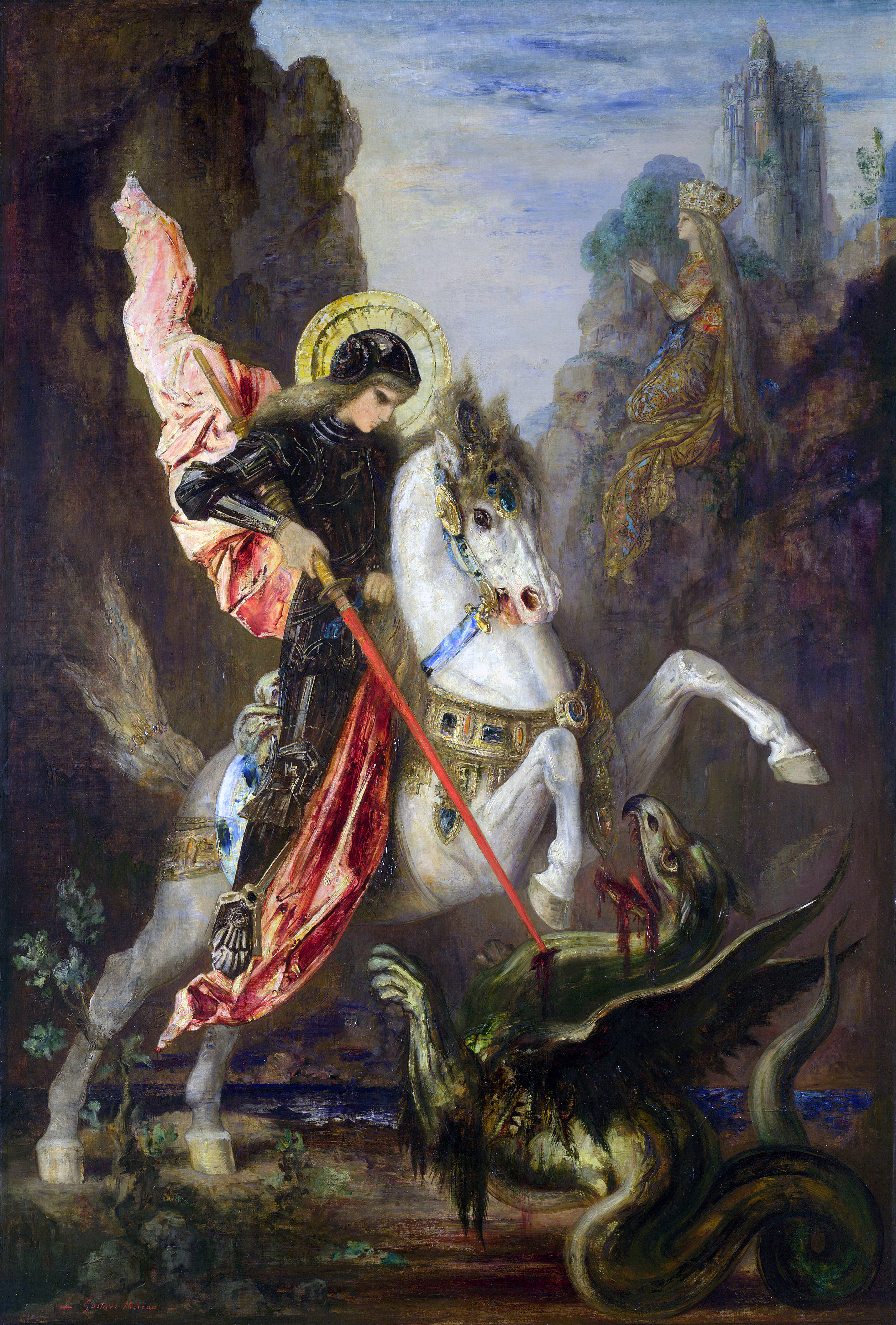
While I was researching various dragon information I came upon how the dragon was used to symbolize sin or paganism in the early church. In The Christian Church during the Renaissance many paintings were made to emphasize this idea, paintings were created depicting church heroes having a dragon tamed, killed or defeated.

We saw a literary example of this in Edmund Spenser’s The Faerie Queene. The final battle of the main protagonist Red Crosse was fought against a dragon. It took all of Red Crosse’s strength (and some magic to defeat the dragon) which clearly symbolizes the fight against sin. Also, it took Crosse three days to defeat the dragon which can be compared to Christ’s crucifixion and coming back to life in three days to defeat sin. The painting at the beginning of this blog is a depiction from the Renaissance of St. George, the patron saint of England, defeating a dragon. St. George is an extremely revered saint in the Anglican Church which shows that the dragon might be a symbol of The Roman Catholic Church whose “evils” were destroyed with the creation of the Anglican Church under Henry VIII.

Tuesday, December 2, 2008

Ferdinand: A Real Animal


In John Webster’s The Duchess of Malfi one sees various descriptions of the story’s characters. These descriptions, however, become interesting when the reader starts seeing that Webster uses animals to portray his characters. At first, he uses the more common creatures like spiders, crows and leeches to describe the Duchess’s brothers. Soon though, one begins to see in more detail the true character of the brothers Ferdinand and The Cardinal, especially that of Ferdinand, and with this new view one can understand why Webster uses his creature descriptions.

One begins to see that Ferdinand is a predator who preys upon others with no regard to anything but his own grasp of the situation. He shows a strange feral nature in his fascination/obsession with the sexual and procreation. This animal nature is only amplified by the fact that his obsession is linked incestuously with his sister. Ferdinand also yearns for complete control like a territorial creature. Finally, the reader also sees Ferdinand’s selfishness exhibited like a dying animal who only cares for itself.

Seemingly to make a final point on how corrupt Ferdinand’s existence is Webster decides to diagnose him. In Act 5 the Doctor tells Pescara that Ferdinand has “lycanthropia” or that that he is a werewolf - “Said he was a wolf, only the difference/ Was, a wolf’s skin is hairy on the outside,/ His on the inside.” This final emphasis makes Ferdinand seem utterly inhuman making him an ultimate antagonist.